
Edna Longley’s speech when announcing the winners
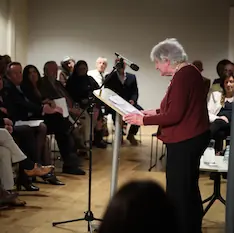 Since 1977 the Ewart-Biggs Memorial Prize has been a marvellously positive response to an appalling tragedy. In 1993 my late husband, Michael Longley, presented the prize to Brian Keenan for An Evil Cradling. Michael’s speech on that occasion quoted Homer as regards the importance of strangers and visitors in the culture of ancient Greece. Michael said that ambassadors ‘are strangers and visitors’ in a special sense; that ‘a sacred trust should surround them’; that the murder of Christopher Ewart-Biggs was therefore ‘a desecration of the darkest kind’. He also said that whenever this prize is awarded we ‘participate in some kind of continuing expiation’ – as we are doing now. Revisiting Michael’s words, with their Homeric tilt, makes me wonder whether presenting the Ewart-Biggs Prize was somewhere at the back of his mind when he wrote his poem ‘Ceasefire’ the following year.
The purpose of the Prize is to promote ‘peace and reconciliation in Ireland and greater understanding between the peoples of Britain and Ireland’. I have a personal stake in this archipelagic scenario, since I had an Irish father and a Scottish mother, and I moved from Dublin to Belfast in the early 1960s. Even today, I’m occasionally asked how I felt about moving North, and might reply: ‘I’m still suffering from culture-shock’. My favourite reaction of a southerner to the North was when the Galway poet Rita-Ann Higgins came to give a reading in Belfast, accompanied by her husband, Christy, whose first northern visit it was. Christy walked around the city during the day while Rita-Ann performed poet-duties. When they met up later, he said to Rita-Ann: ‘We’re in Canada.’ Not the worst place to be at the moment, perhaps. But I definitely feel that the term ‘greater understanding’ should also cover the cross-border axis. In one of the short-listed books, For and Against A United Ireland, Fintan O’Toole mentions the statistic, that during a recent five-year period, 65% of northerners had taken a day-trip to the south – probably to Dublin or Donegal – but only 29% of southerners had taken a trip north. Two-thirds of southerners also said that they had no friends in the North.
An unusual aspect of the Ewart-Biggs Prize is how it crosses genres and media. As regards books – this year’s shortlist is all books – the genres have included memoirs (like Keenan’s); innovative historical and political studies; the overwhelming archive Lost Lives; fiction, as by David Park and Anna Burns; poetry: I was delighted when Gail McConnell of this parish won the prize for her powerful collection The Sun is Open. I think that to associate such diverse works in terms of how they educate or enlighten perpetuates a kind of intellectual common purpose that developed during the Troubles. So perhaps the nature of this prize epitomises what Michael means by ‘civilisation’ in his poem ‘All of these People’: a title which another Ewart-Biggs winner, Feargal Keane, adopted for a book of his own. I would like to read the poem:
ALL OF THESE PEOPLE
Who was it who suggested that the opposite of war
Is not so much peace as civilisation? He knew
Our assassinated Catholic greengrocer who died
At Christmas in the arms of our Methodist minister,
And our ice-cream man whose continuing requiem
Is the twenty-one flavours children have by heart.
Our cobbler mends shoes for everybody; our butcher
Blends into his best sausages leeks, garlic, honey;
Our cornershop sells everything from bread to kindling.
Who can bring peace to people who are not civilised?
All of these people, alive or dead, are civilised.
That poem, like ‘Ceasefire’, not only applies to Northern Ireland. Nor does all the writing and thinking sparked by the Troubles, all the contributions of Ewart-Biggs winners. Per head of the population, Northern Ireland has possibly been more anatomised than any other place in the world. And, just as that body of work has implications for other troubled places; so here we should not see it as attached to the past. This is so, even if identities and identifications have, to some degree, shifted throughout Ireland. When Katy Hayward was awarded a Ewart-Biggs ‘special prize’, she stressed how the end of violence depended on ‘the tireless work of diplomats and civil servants, the courage of politicians and civic leaders, and the selfless indefatigability of quiet peacemakers’. She also warned that such progress is ‘vulnerable to change’, that it can be lost if not worked at. Naomi Long echoed that warning at the Alliance Party conference last weekend.
We can all think of countries where civilised progress has been reversed. Thus I would like to link the objectives of the Ewart-Biggs Prize with the embryonic Office of Identity and Cultural Expression which was set up here last October. I hope that our new Civil Service body will neither pander to cultural politics, including the importation of American culture war, nor try to reinvent the wheel, but will consult the rich existing mass of writing and thinking about its remit. This includes the ‘cultural traditions’ conferences initiated at the end of the 1980s. The first conference was called ‘Varieties of Irishness’, and I vividly remember Roy Foster delivering his keynote address. That was an important moment.
In some ways, the book which has won the 29th Ewart-Biggs Prize brings us back to Varieties of Irishness. It also satisfies my own desire for advances in cross-border understanding, especially with its clever structure whereby two brilliant journalists walk in one another’s shoes as well as their own. I gave this book as a Christmas present to my grandson Conor, a politics student at Edinburgh University. He thinks it’s terrific.
I am glad to announce that the winner of the Ewart-Biggs Memorial Prize is, of course, For and Against a United Ireland by Fintan O’Toole and Sam McBride.